
Uncategorized

Permission To Rest

On Forcing. Waiting. And What Arrives in Between.

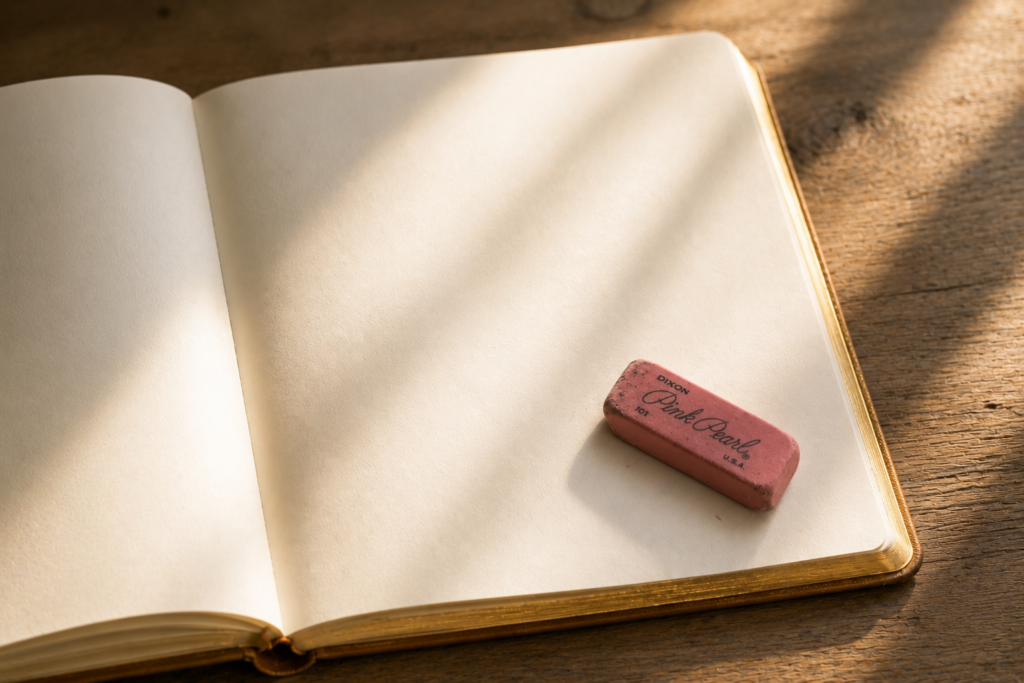
I was going to begin my new journal with a fully formed piece. Title and all.

Then nothing came.

The pencil was still. The page remained empty.

I sat with it. Left it. Came back. Left again. Returned. Still nothing. Just a blank page beneath a title that sat at the top like a demand — waiting to be satisfied by words that hadn’t arrived yet.

And then I noticed something almost funny.

I was already doing the thing I had hoped to write about. Asking myself to produce what wasn’t ready. Reaching for the fully formed before the seed had even broken ground.

So I erased the title.

And something shifted immediately. A physical thing. The tightening loosened. The constriction of forcing — and it is a physical sensation, that constriction — began to release. The page was just a page again. And I began to write what was actually happening.

Which, it turns out, was everything I needed.

Here is what I know about the mind.

It is a remarkable interface. Precise, fast, endlessly capable within its domain. But it was not designed to be the origin of things. It was not built to generate truth from nothing, to manufacture certainty where none exists, to produce the fully formed from the not yet ready.

The mind is a translator.

It takes what arrives — from the body, from the field, from the deeper knowing that moves beneath thought — and gives it language. Form. A shape the world can receive.

That is its job. And it is extraordinary at that job.

But when we ask it to be the source as well as the translator — when we place a title at the top of a page and ask the mind to fill what lives beneath it — something goes wrong in the system.

The mind tries. Of course it tries. It has learned to respond to demands. To spin when it cannot deliver. To generate noise in the place where signal hasn’t arrived yet. And in the trying — in that gap between what we’re asking and what is actually possible —

The tightening begins.

The anxiety. The frustration. The going under.

This doesn’t happen because something is wrong with us.

It happens because we asked the wrong thing of the right instrument.

There is another way.

It is not a new technique. Nor a practice with steps to follow. Something simpler and more difficult than that.

Permission.

Permission to let the mind occupy its rightful place. To stop asking it to generate what only arrives when we are still enough to receive it. To stop mistaking the translator for the source.

When I erased that title from the page something released in me that I hadn’t realized I was holding. The demand lifted. And in the space that opened —

I began to write what was true.

Instead of what I thought should be there. Instead of what I imagined a blog piece ought to look like. I wrote what was actually present. The empty page. The still pencil. The almost comic recognition that I was already doing the very thing I had hoped to write about.

That recognition didn’t come from thinking harder.

It arrived. The way things arrive when the mind is finally relaxed enough to receive them.

Because the mind at its truest — at its most coherent — is not the one who thinks for the soul. It is the one who becomes transparent enough that the soul may think through it.

A transparent mind is not a blank mind. It is not a switched off or bypassed mind.

It is a mind that knows its role.

Its right relationship to the whole.

And when I finally stopped asking for what it simply cannot give —

The mind spoke.

Not in the way I had been demanding. Not with the fully formed essay, the perfect title, the arranged sentences.

Quietly. Simply. Words that carried everything.

If you’d only let me rest.

I have thought about this question of waiting. Of giving the mind what it asked for.

Because there is a fine line — and I have felt it in my own body — between remaining open and beginning to force. Between trusting the seed and anxiously digging it up to check whether it has sprouted yet.

On one side of that line there is spaciousness. Room to receive. The mind doing its quiet work of translation without being asked to also be the source of what it translates.

On the other side — the tightening begins. The spinning. The going under that comes from swimming too hard against a current that was never asking to be fought.

I find myself laughing sometimes at that edge.

It isn’t that it’s funny exactly.

It’s because the recognition arrives — that I am about to ask the impossible of myself again. That the demand has crept back in wearing a different face. And the laughter is its own kind of release. A loosening. A returning to the side of the line where waiting is not failure.

Where waiting is, in fact, the most honest thing available.

Can I let a seed sprout, send roots, reach the surface?

Can I let my mind be still enough to receive what my soul wants translated?

I am learning that this is always a question of trust.

And I have found one thing to be consistently true —

Nothing true has ever been harmed by waiting until it is ready to speak.

Permission To Rest Read More »

When Worlds Collide

On Coherence, Absorption, and the Field That Sorts Itself

There is a particular kind of afternoon that teaches you something without announcing itself as a lesson.

We were finishing up at the barn. Horses put away, tack cleaned, the easy quiet that follows a good ride settling over everything. And then a flatbed pulled up.

What arrived wasn’t just a truck. It was a world. Complete with its own internal logic, its own patterns, its own way of moving through space. And within minutes that world had begun installing itself — literally — into a field that already existed. That had its own rhythms. Its own unspoken agreements. Its own coherence.

I watched. I noticed. I didn’t need to intervene — the observation itself was enough.

And what I noticed has stayed with me.

You know the feeling.

You walk away from an interaction and something sits slightly off in the body. Nothing dramatic occurred. No one was unkind. There were even apologies.

And yet.

A disturbance is there that wasn’t before. A displacement you can’t locate. You’re tired in a way that doesn’t match what you did.

You absorbed something. And because it had no name — you couldn’t set it down.

This is what happens when worlds collide.

We each carry one. A world. Built over time from our patterns, our relationships, our particular way of organizing reality and moving through space. Most of the time we aren’t aware we’re carrying it. It simply moves with us. The way a field moves with a body.

And we are always — whether we know it or not — making contact with other worlds.

Most of that contact is unremarkable. Worlds that have developed in proximity tend to attune to one another over time. They find a shared rhythm. Unspoken agreements form. A mutual field develops that holds everyone within it comfortably.

But sometimes a world arrives that hasn’t attuned. That doesn’t pause at the threshold to feel what’s already there. That moves straight into the existing field and begins — not out of malice, but out of simple unawareness — installing itself.

And the field feels it.

Even when no one can name it. Even when everything on the surface appears perfectly pleasant.

Here is what happens in that contact.

The field absorbs. Almost automatically. Because we have been taught — not in words but in ten thousand small moments — that when something arrives, we receive it. When someone apologizes, we accept. When disruption enters, we smooth it over. We say it’s fine before we’ve even checked whether it is.

It feels like kindness. It looks like kindness.

But there is a difference between kindness and accommodation. Kindness sees the person. Accommodation serves the system. And most of us, most of the time, cannot tell them apart in the moment because the social reflex moves faster than awareness.

So we absorb.

And the body keeps the real accounts.

Because what enters the field doesn’t disappear simply because the interaction ended. The disorganization stays. It moves through the system looking for form, looking for a name. And here is the quiet cost of absorption without transformation —

You cannot still what you cannot identify.

The disturbance accumulates. Not dramatically. Quietly. In the unnamed tiredness after certain interactions. In the vague sense of displacement that has no visible cause. In the feeling of having given something you didn’t agree to give.

The field has been moved without its consent.

And it doesn’t know how to account for it.

So, what is the alternative?

Not defensiveness. Not walls. Not the aggressive protection of a world that has decided nothing gets in.

Something quieter than that. And stronger.

Coherence.

The word circulates now in spiritual spaces, in wellness conversations, in the language of those seeking something more solid to stand on. And most people feel they understand it. They nod when they hear it.

But do they know it in their body?

Do they know what it feels like to stand next to someone who has it? That particular quality — not of hardness, but of settledness. Of a person who is fully themselves and makes no apology for it. Whose presence somehow asks — without asking — that your field become more organized simply by being near them.

Coherence is not a concept. It is a living quality.

It is a world that knows what it is.

That has been shaped by experience, tested by friction, moved through contact with other worlds — and has returned, each time, to its own nature.

Being great, it flows. It flows far away. Having gone far, it returns.

The Tao knew this. What is truly coherent cannot be permanently disorganized by what it moves through. It makes contact. It feels the friction. It may even be temporarily moved.

But it returns.

Coherence does not announce itself.

It doesn’t arrive explaining what it is or asking to be recognized. It doesn’t defend its borders or perform its steadiness for an audience. It carries no need to convince you of anything.

It simply — is.

And this is what makes it so unfamiliar. We live in a world that has confused coherence with rigidity. That mistakes boundaries for walls. That thinks remaining yourself in the presence of a disorganizing force requires effort, assertion, the active pushing away of what doesn’t belong.

But true coherence doesn’t push.

It doesn’t need to.

When a world that hasn’t attuned enters a coherent field, something happens that requires no action, no confrontation, no smoothing over. The coherent field simply continues being what it is. And in that continuity — in that quiet, undefended remaining — the disorganizing force finds nowhere to install itself.

Not because the door was locked.

Because there was no circuit to complete.

The apology lands on nothing. The advance finds no accommodation. The system that relies on other systems not noticing it — is noticed. Clearly. Without drama. Without judgment.

And the one who notices doesn’t announce what they’ve seen.

They simply don’t complete the circuit.

That is coherence in action.

Not a wall. Not a weapon.

A world that knows what it is, has been tested, and remains.

Coherence is fully itself.
It knows what it is.
It does not dissolve.

It does not chase.
Does not convince.
Does not apologize for itself.

It has been tested.

It simply remains.

And offers the only conditions
under which something real
can happen.

The field around it
sorts itself naturally.

Resonance, like water.
Gathering or leaving.
Filling the gap.
Or leaving it empty.

You have felt coherence. Even if you didn’t have a name for it.

You have stood next to someone who had it and felt yourself — without knowing why — become more still. More yourself. As if something in you recognized something in them and quietly reorganized around that recognition.

And you have felt its absence. In the accumulated tiredness. In the unnamed thing you carried home from an interaction that looked perfectly fine on the surface. In the low persistent sense that somewhere in the exchange you moved away from yourself.

This is not abstract. This is the body keeping its real accounts.

Coherence is not a destination. It is not achieved once and held forever without tending. It is a returning. Again and again. To your own nature. Through every contact, every collision, every world that moves through yours without asking permission.

Being great, it flows. It flows far away.
Having gone far, it returns... to it’s nature.

This is the invitation.

Not to harden. Not to close.

To know yourself so completely that the field around you sorts itself naturally. That what is seeking coherence finds it in your presence. And what cannot tolerate it —

Finds its own way home.

When Worlds Collide Read More »

The Doorway Has Already Been Crossed

When I listened for what wanted to come forward this month, I found myself reflecting on how much energy we spend trying to manage life.

Not our actual lives. Not the things that have been placed into our hands.

Everything.

The future.
Other people.
The state of the world.

Outcomes we cannot yet see.
Problems we cannot yet solve.

It is a heavy way to live.

What strikes me is how naturally we assume that responsibility.

We carry concerns that belong to tomorrow. We carry situations that belong to someone else. We carry possibilities that may never come to pass.

And while we are busy carrying all of that, the life directly in front of us quietly waits to be lived.

A conversation.
A garden.
A relationship.
A meal.

A single decision.
A single step.

There is a difference between participating in life and attempting to manage it.

The older I get, the more I wonder if wisdom has something to do with recognizing that difference.

Perhaps our task is not to carry the world.

Perhaps our task is to tend the small piece of it that has been entrusted to us, while trusting that something larger is tending the rest.

What Belongs To Us

Part of the burden comes from forgetting what truly belongs to us.

Not forgetting in a dramatic sense.

Simply becoming so immersed in the experience of life that we begin carrying things that were never ours to carry.

Our attention drifts beyond the boundaries of our own world.

We become concerned with outcomes we cannot influence, situations we cannot resolve, and responsibilities that do not belong to us.

Before long, we find ourselves trying to manage realities for which we have neither the authority nor the tools.

No wonder we become overwhelmed.
No wonder we become exhausted.

Life gives us what is needed for the life we are actually living.

For the conversation in front of us, the relationship we are nurturing, the work that has been placed into our hands, and the choices that belong to this season.

We are equipped for our participation, not for managing the entire world.

There is a strange relief in recognizing this.

Not because we stop caring, but because we begin to understand the difference between caring and carrying.

One opens the heart.
The other weighs it down.

Perhaps wisdom is not learning how to carry more.

Perhaps wisdom is learning what belongs to us and what belongs to Life and having the humility to know the difference.

A World Measured By Depth

When we stop carrying what does not belong to us, something unexpected happens.

Our attention comes home.

The conversation we were only half listening to becomes vivid again.
The beauty of an ordinary afternoon returns.
The people we love become more important than the problems we cannot solve.

Life regains its texture, its immediacy, its aliveness.

We discover that our world was never as small as we imagined.

A world is not measured by its size.
A world is measured by its depth.

A single friendship contains a world.
A family contains a world.
A garden contains a world.
A community contains a world.

Even a quiet moment of presence contains a world.

The future is influenced here.
The larger world is influenced here.

Not through our ability to manage everything, but through our willingness to fully inhabit what has been entrusted to us.

We are not separate from the greater whole.

We are one expression of it. And our small corner of life is one of the places where that greater intelligence is seeking to become visible.

The Small Step

There is another habit many of us share.

When we do not know what comes next, we often imagine that the answer must arrive in a grand form.

A breakthrough.
A revelation.
A dramatic change of direction.

Something large enough to remove all doubt.

Yet life rarely seems to move that way.

More often, it arrives as a small invitation.

A conversation worth having.
A call worth making.
A class worth taking.
A seed worth tending.

A single step that appears almost too ordinary to matter. And because it appears so ordinary, we are tempted to dismiss it.

We tell ourselves that it cannot possibly be enough.

Surely something bigger is required. Something more significant. Something that looks more like destiny.

Yet what if the small step is the destiny?

What if the path is not hidden behind the next ten years, but quietly waiting inside the next honest choice?

Many of us want to leap to the outcome.

We want certainty before the experience, arrival before the journey, the view from the mountaintop before the climb.

Yet the growth we seek lives in the steps between.

The relationships.
The discoveries.
The unexpected turns.

The person we become while walking.

A life is not built through a single grand gesture. A life is built through thousands of small participations.

And perhaps that is why the next step often appears smaller than we expect.

It is not asking us to become someone else… It is simply asking us to continue.

Life Meets Us

Looking back across my life, I rarely had the full picture.

I almost never knew where a path would lead when I first stepped onto it.

A friendship began as a simple conversation.
A calling began as a curiosity.
A turning point arrived disguised as an inconvenience.
A loss became a doorway.
A question became a teacher.

Again and again, life revealed itself one step at a time.

Not because the path was absent.
Because I was walking it.

There is a difference.

The next step often becomes visible only after the current one is taken.

Perhaps this is one of the quiet mysteries of being human.

We want certainty before participation.
Life invites participation before certainty.

We want the entire map.
Life offers the next piece of ground.

And somehow it has always been enough.

Not enough to eliminate uncertainty.

Enough to continue.
Enough to learn.
Enough to grow.

Enough to meet the life that was waiting on the other side of the step.

Already Here

Sometimes I wonder if we spend so much time looking ahead that we fail to notice how much life has already met us along the way.

Not always in the form we expected.
Not always in the timing we preferred.

Yet when I look back, I can see countless moments when what was needed arrived when it was needed.

A person.
An insight.
A skill.
A lesson.
A doorway.

Rarely before its time.
Often just as it became necessary.

This does not mean every experience was easy.
It does not mean every chapter unfolded according to plan.
It simply means that Life has never been a one-sided conversation.

We participate in it… and it participates in us.

Something responds.
Something meets us.
Something unfolds in relationship with our willingness to take the next step.

This may be why certainty is so elusive.

If we already knew everything that lay ahead, there would be little reason to participate, little reason to discover, little reason to grow.

The path would become a script instead of an experience.

Yet life seems less interested in scripts than in relationship.

It invites us forward.
We respond.
It reveals another piece.
We respond again.

And through that ongoing exchange, a life takes shape.

Not all at once.

Moment by moment.
Choice by choice.
Step by step.

The Doorway

I think this is why I find myself less concerned these days with where the path ultimately leads.

I am more interested in the fact that I am already on it.

Already participating.

Already in relationship with a life that has been unfolding one step at a time from the moment I arrived.

And this is what I keep returning to…

The doorway has already been crossed.

We are here.

Not someday.
Not when everything is figured out.
Not when every uncertainty has been resolved.

Here.

In this life.
In these relationships.
In this season.
In this moment.

The invitation is no longer to arrive.
The invitation is to participate.

To care for what has been placed in our hands. To love what is within reach. To tend our corner of the world with sincerity and attention.

And to release the burden of carrying what was never ours to carry.

There is a certain humility in this.

A recognition that life is larger than our plans, larger than our worries, larger than our attempts to manage every outcome.

Yet there is comfort in it as well.

Because if life possesses an intelligence of its own, then we do not walk alone.

We never did.

Something has been meeting us from the beginning.
Something has been participating with us all along.

Perhaps wisdom is not found in seeing the entire path.
Perhaps wisdom is found in recognizing that we were never asked to.

We were given this step.
This day.
This conversation.
This opportunity to care.

And perhaps that is enough.
Perhaps it has always been enough.

Not because the journey is small.

But because life seems remarkably capable of revealing the next piece of the path when it is time.

So we take the step.

We tend what is ours to tend.
We participate in the world that has been entrusted to us.
And we allow the larger world to be held by something larger than ourselves.

Maybe we arrived carrying exactly what was needed for the journey.

Not everything that would ever be needed.

Simply enough for the next doorway, the next relationship, the next season of becoming.

A BlessingBefore You Go

The Doorway Has Already Been Crossed Read More »

Someone Still Does Know How To Love

It was a rainy Christmas Eve as we made our way through a crowded church toward a space just large enough to seat my family—my mom and dad, my younger siblings, and our Nana. We had moved to the Midwest while I was in middle school, and my Nana had come to visit from California. She went to daily mass and had already acquainted herself with the people and the priest at our “potato chip church.” We called it that because the roof was shaped like a Pringle. She was also a deeply spiritual woman in her own way, beyond the church. So, there we were, in our best Christmas clothes.

The Mass moves through rhythm, participation, and order—standing, kneeling, reading, responding, praying, singing. There is a moment when the people are invited to share the sign of peace with their neighbors. They usually hug their families first, then turn around and shake hands with one or two strangers, saying, Peace be with you. It is meant to be open and friendly. And sometimes it is, but often it is sterile. When it is done, everyone returns to stillness, facing forward, and waits for the priest to begin again.

In this instance, the priest was unable to continue.

My Nana, from her place of lived ritual, had left our pew to share peace with more people.

Why stop at two?

She was hugging everyone—and they received it. The priest was visibly flustered, and my dad was rolling his eyes while laughing under his breath. At first, we children sat wide-eyed, unsure what was happening. But by the time she reached the front of the church, near the altar, we were laughing.

After standing there a while, unsure how to regain control, the priest finally addressed my Nana by name and asked her to return to her seat.

She hugged a few more people on her way back.

He was trying to hold the structure and continuity of ritual, while she, holding a deeper reverence, had entered the field of living ritual. He was faced with continuing the process around her—the living essence of love and relationship.

If you had received a hug from her that day, you would have experienced the luminous coherence beaming from her eyes.

I did not understand at the time what I was actually witnessing.

But through my own small human movements, I was recently reminded that I know this.

It lives in me—this atmosphere of love and laughter, where play is normal, touch is natural, and belonging is assumed.

A few days ago, my son was at our home working on his new business before heading to an appointment.

I watched him make a little breakfast and refill his coffee, and I felt glad there was enough for him.

He asked about his dad’s new venture and said,
“It is good to be excited for someone.”

I replied,
“Yes, but aren’t you excited for yourself?”

He said,
“I am choosing a vortex thought.”

I paused, then said,
“Well, I am excited for you—and that is a vortex thought.”

He smiled, and we both laughed.

A moment later, after I had gone back to my project in my creative space, he came upstairs to ask my opinion. I gave it happily.

Instead of going back downstairs, he sat in a chair near my space—dog nearby—and remained quietly working in the atmosphere that had just been held open for him.

When his dad came into the kitchen a little later, my son, the dog, and I all found our way there. We shared space, our work, more coffee, a little more breakfast—

and a lot more laughter.

Lately, I’ve been remembering that what nourished me most deeply growing up was not perfection, but atmosphere.

And this moment with my son touched something old and familiar in me—a way of holding life beyond survival mode, in playfulness, ease, laughter, and trust.

I wanted to write about the field from within which everything arises and is held in relationship—the pre-form state of thought, substrates, particles, the nature of reality itself.

But my Nana arrived to remind me of something deeper.

The field is not only perceived in mystical states.

It is transmitted through how people feed one another, laugh together, touch, welcome, hold uncertainty—how they keep life circulating through relationship.

Family meals.
Gatherings.
Warmth.

The relational atmospheres we create around one another—these are not small things.

They are the deeply human expression of cosmology, field theory, and coherence.

Where the architecture becomes lived.
No longer abstract.
No longer distant.
But embodied in ordinary moments that carry extraordinary coherence.

It is a human being responding directly to the living essence in others, without self-consciousness.

It is doctrine, ritual, structure—pausing around the reality of living love moving through the room.

What my soul recognized before my mind understood was this:

the continuity of life force moving through relationship.

A field we participate in shaping in every small human exchange.

It invites us to play.

Warmth, hospitality, humor, touch—these are what widen the field, allowing others to enter into relationship.

I saw it in my Nana, in the way she moved through the world, circulating peace.

She fed the field.

I saw it in my son—choosing his vortex thought, reorganizing the atmosphere in a moment of shared laughter.

And I recognize it in myself, where coherence shifts the field from scarcity to continuity, allowing the atmosphere to become breathable again.

This way of living is not lost.

The field moves toward life, toward relationship, toward embodiment—through ordinary moments.

It lives through people who hold atmospheres of shared aliveness, who enter the field directly and open it—

not through perfect lives,
but through true human expression.

And when you feel it, you will know.
Not because it is explained, but because something in you recognizes it.
Someone still does know how to love.

Someone Still Does Know How To Love Read More »

The Openness That Does Not Want To Be Filled

There is a kind of openness that does not feel like lack. It does not ache to be filled or resolved. It does not reach for the next idea, the next insight, the next form. It simply remains… open.

Not waiting. Not searching. Not incomplete in the way we’ve been taught to recognize incompleteness.

And because of that, it can be easy to misunderstand.

We are so accustomed to filling space—to turning quiet into something useful, to translating stillness into movement—that when nothing arrives, we assume something is missing. But what if nothing is missing?

What if the openness itself is intact, and the impulse to fill it is what distorts it?

There is a difference between a space that is empty because something has not yet come, and a space that is open because it is not meant to be filled—not yet, or not in the way we expect.

And sometimes… it is not that nothing is there. It is that what is there has not taken a form we know how to recognize.

So we wait for it to become something we can name.

But it does not always respond to that kind of waiting.

It does not always arrive as clarity.

Sometimes it remains as a kind of quiet presence—felt but not defined.

And if we do not move too quickly, there is a moment where the need to define it begins to soften. Not because we understand it, but because we no longer require it to become something else.

And perhaps it is not the space that is empty, but our capacity to meet it that is still forming.

There is a kind of openness that does not ask to be filled.

And it does not diminish when it is left as it is.

The Openness That Does Not Want To Be Filled Read More »

Staying Too Long

When We First Know

Intuition rarely speaks in sentences.

It speaks in geometry — small distortions in the field, shifts in tone, subtle misalignments that appear before the mind has language for them. The moment the signal arrives, it is quiet but unmistakable: something here is turning.

There is no drama in the first knowing.

It’s simply the feeling of being slightly off-center in your own life, the way the body tightens just enough to hold itself against a truth it has already registered. The breath shortens. You step a little ahead of the moment or a little behind it, but not quite inside it. Some part of you has already begun to step back, even if the rest of you is still catching up.

And because the signal is subtle, we often override it.

When We Override Ourselves

We do not override intuition because we are confused.

We override it because compassion — or uncertainty, or loyalty — rushes forward ahead of clarity. We tell ourselves the tightening could mean anything. That we need more time. That perhaps we are misreading the moment.

So we soften. We wait.

We give another benefit of the doubt.

But intuition doesn’t disappear.

Each override causes the body to contract a little more, the breath to shorten, the inner dissonance to sharpen. What was once a whisper becomes a pressure — not accusatory, just persistent — the architecture of truth asking to be acknowledged.

Eventually, the cost of overriding becomes heavier than the cost of listening. That’s when we begin to face the deeper question:

The Hinge Moment

There was a moment not long ago when I noticed this happening in real time. I was sitting in a conversation that had once felt collaborative and easy, and yet something in the exchange had quietly changed. The signals were small — a shift in attention, a certain absence of presence — nothing dramatic enough to name out loud.

But I could see it.

I could feel the moment the current of the interaction went still. What had once moved easily between us no longer flowed. In its place there was a kind of quiet emptiness — the subtle feeling of something that had once been alive now standing hollow.

I was still sitting there, still speaking, still participating in the conversation, and yet another part of me knew the shape of it had already completed.

I could see it.

But I wasn’t ready to say it yet.

Not because the knowing was unclear, but because there is often a moment — a very human moment — when we stand inside recognition before we choose what to do with it.

The knowing arrives first.
The choice to speak it comes a little later.

Why We Stay

Even when the truth is clear, leaving is rarely simple. We don’t stay because we’re confused — we stay because endings require a particular kind of courage that few of us are taught to cultivate. Walking away means acknowledging that something is complete, and many would rather tolerate discomfort than face the finality of that knowing.

We stay because we hope the shape will change.
We stay because we don’t want to hurt someone.
We stay because we want the story to resolve cleanly.
We stay because it feels easier to wait than to disrupt.
We stay because stepping out means stepping into the unknown.

And sometimes, we stay because we don’t want to be the one who names the ending. Initiating an ending forces us to stand squarely inside our intuition — not as a feeling, but as a decision. It makes our knowing undeniable. It asks us to acknowledge that no new information will arrive to rescue the situation from what it already is.

So we linger.
We postpone.
We give it another week, another conversation, another benefit of the doubt.

But beneath all of that, the deeper truth remains:

we stay until the cost of staying becomes heavier than the cost of leaving.

That is the moment the pattern breaks — the moment we begin to cultivate intentionality, not because the ending becomes easier, but because we finally stop overriding the part of us that already knew.

When Clarity Arrives

Clarity doesn’t burst in; it returns.

It rises the way truth always does — quietly, steadily, without needing to debate or persuade. Something loosens inside. The tension that once held you in place releases. You see the shape of what you were in, how long you sensed it, and the steps you took past your own knowing.

There is softness in this recognition, not shame.

Clarity restores coherence instantly.

In one moment, you come back into alignment with yourself.

But alignment doesn’t erase emotion.

It simply makes space for what comes next.

The Courage To Choose

Every ending, even the right one, asks for courage — not the loud kind, but the steady kind. The courage to honor what your body has known for weeks or months. The courage to step out before the path ahead is illuminated. The courage to disappoint someone, or to be misunderstood, or to let the story end without tying it neatly in a bow.

Courage is simply the moment when clarity becomes action.

And action — real action — asks us to feel what comes next:

The Grief That Follows

Even aligned decisions carry grief.

The body needs time to recalibrate. The heart needs time to let go of the version of the story it once hoped for. And the mind, being human, often searches for a place to put the regret:

“I should have seen it sooner.”
“I should have acted earlier.”
“I should have trusted myself the first time.”

But this grief is not evidence of a mistake.

It is evidence of care.

Grief is how the system completes a cycle.
It is how identity acknowledges what mattered.
It is how the heart metabolizes the truth that something real has ended.

The grief doesn’t contradict the clarity.

It accompanies it.

The Human Pattern Beneath It All

There is no shame in the ways we hesitate. Humans are designed to bond, to hope, to try, to extend grace. We want things to work. We want people to be who they once were. We want our care to matter. Most of all, we want to believe we didn’t misread the moment — that the tightening in the body was temporary, that the misalignment was repairable, that clarity would arrive without requiring change from us.

But every ending carries its own intelligence.

Overriding intuition is not failure; it is simply the point in the journey where the heart and the mind are not yet ready to act on what the body already knows. And when we finally do act — when we choose alignment over attachment — we often encounter waves of grief, regret, tenderness, and self-blame. Not because we did something wrong, but because endings awaken every place in us that once hoped for a different outcome.

This grief is not a sign that the decision was incorrect.

It is a sign that the decision mattered.

In time, the system settles.

The breath opens.

The clarity roots itself.

Self-trust repairs the places where hesitation once lived.

And what remains is not the ending itself,

but the quiet strength of someone who listened —
finally —
to the truth that had been speaking within them all along.

The Return To Self

Returning to intuition is not about correcting a mistake; it’s about reclaiming your center. It’s the moment when you re-enter the rhythm that has always been yours. The breath deepens. The body settles. The field becomes coherent again.

And in that coherence, something steady rises: the recognition that your inner knowing has never been punitive or impatient.

It simply waits — with quiet fidelity —
for you to trust what you sensed the first time.

Staying Too Long Read More »

Almost In Orbit

A story about a horse who teaches me the language of truth

Rocket

It was one of those rare California winter days that feels borrowed from another season—quiet, warm, sunlight stretching itself across the ranch like it had nowhere else to be. The horses were calm, dozing in the glow, and for once my mind matched them. No rush, no tension, no expectation. Just presence.

I hadn’t come to ride Rocket that day. I was there to say hello, check waters, brush a few coats, and enjoy the soft rhythm of barn sounds. But as I moved down the line of stalls, Rocket lifted her head and walked straight to the fence.

She didn’t pin her ears or stick her head through the fence for a treat. She didn’t even whicker. She simply stood there … quiet, still, intentional.

My daughter glanced over.
“See?” she said. “She’s trying to tell you.”

And she was.
I could feel it before the words formed: a gentle, unmistakable signal in that way Rocket speaks—mind to mind, image to image.

If you want to ride, I’ll let you.

It wasn’t pressure. It wasn’t demand. It was permission, offered with that unique mix of honesty and humor she carries—the kind that makes you feel both seen and lovingly called out.

I scratched her forehead and gave her a soft, thoughtful “hello,” but I didn’t commit. Some small remnant of our earlier rides—my nerves, her intensity—still lived somewhere in my system. So, I let the moment pass and went back to what I was doing, pretending I hadn’t just been invited by one of the sharpest intelligences I know.

But Rocket doesn’t offer lightly.

A few minutes later my daughter called out, “Do you want to do another lesson on her?”

And that’s where the story really begins.

Three Weeks Earlier: Mutually Escalating Honesty

A few weeks before that warm winter afternoon, Rocket and I had a very different kind of encounter. My daughter had offered to give me a lunge-line lesson on her—a simple circle, walk-trot-maybe-canter if the planets aligned.

I hadn’t ridden Rocket in a while. She and I have a long-standing relationship built on what I now lovingly call mutually escalating honesty. She has no tolerance for pretense, and I, at times, was guilty of trying to “handle” her instead of listening. It did not go well for either of us.

But I agreed to the lesson anyway.

While tacking her up, Rocket spoke first: mind to mind, as she often does.

I’ll give you a lesson, she said.

And without thinking, I answered silently, I know, I don’t know what I’m doing.

Her response was immediate and completely on brand:

It’s about time you admit that.

There was no insult in it. No edge. Just clean accuracy punctuated by humor. When I told my family what she said later, they laughed because it sounded exactly like Rocket: unfiltered truth without a hint of malice.

Once we stepped into the arena, something unexpected unfolded.
I relaxed.
I tuned into her.
And instead of trying to manage her, I let her show me what I wasn’t doing quite right. The fear I’d been carrying from earlier rides—my tension, my uncertainty—just… dissolved. Not all at once, but enough that she felt the shift.

When I got off, she stepped close and pressed her head into my chest. Not a casual brush. A deliberate, affectionate You did it.

That moment changed us.
It softened something in me and honored something in her.
A quiet agreement was formed—unspoken, but unmistakable.

Which is why, when Rocket stood at the fence that winter day and offered me a ride, I believed her.

At least at first.

The Mud: A Boundary, A Test, A Threshold

When I finally agreed to the lesson my daughter suggested, I walked into Rocket’s stall expecting her to be ready. But Rocket had relocated. She stood at the far end of the paddock, parallel to another horse, the two of them aligned like reflections on either side of a fence.

“Come on, Rocket,” I called aloud, halter in hand.

Nothing.

I stepped closer.
Still nothing—no acknowledgment, no flick of an ear. Rocket is many things, but indifferent is not one of them. If she doesn’t respond, there is meaning.

I wondered if I’d misread the earlier invitation.

Maybe she changed her mind.
Maybe she just wanted to sunbathe with her friend.
Maybe I imagined the whole thing.

I walked back out and busied myself with chores until my daughter called, “What are you waiting for? Go get her.”

So, I tried again.

This time I stopped at the edge of the mud—the deep, sticky, boot-stealing kind that I did not want to cross. Rocket stood on the other side of it, still, steady, sovereign.

I know how attuned she is.
Rocket reads images, not insistence.
She responds to coherence, not command.

So instead of slogging through the mud, I stood still and spoke to her the way she prefers:

Mind to mind.
Image to image.

I showed her the picture of our ride—my daughter in the center, Rocket and I circling her, walking and jogging, for fifteen minutes. No pushing. No surprises.

The moment I held that image clearly, Rocket lifted her head, turned toward me, and walked straight through the mud—the very mud I refused to cross.

She stopped in front of me and lowered her head: ready for the halter, ready for the lesson, ready for the agreement we had just made.

In that instant I realized the mud was never an obstacle.
It was a threshold.

Rocket wasn’t asking me to move physically.
She was asking me to move internally.

To choose presence over convenience.
Clarity over assumption.
Signal over fear.

I did not cross the mud.
I crossed into her language.

The Eye-to-Eye Moment

At the cross-tie, as I brushed her shoulder, Rocket turned her head and brought her eye directly to mine. Eyeball to eyeball. Too close for pretense. Too honest for anything but truth.

It felt like stepping into a temple.

Without speaking, I said to her:

You are the teacher.
I am the student.

The moment those words settled between us, Rocket softened—not her strength, not her alertness, but her essence. A kind of refined, effortless majesty moved through her.

Not the kind of power that needs to be proven—
the kind that simply is,
made tender by recognition.

She returned her head forward calmly, waiting for the saddle. The ceremony was complete.

What followed in the arena was exactly what I had shown her: fifteen minutes, both directions, nothing more. Rocket holds energetic contracts with strict, almost comic integrity. If I try to sneak in an extra lap, she will tell me immediately—usually in a way that forces me to laugh and acknowledge she’s right.

But that day, there was no resistance.
Just alignment.

Gravity, Grace, & The Teacher Named Rocket

Rocket’s papered name is Almost in Orbit, and she embodies it perfectly. She carries the tension between restraint and launch; between gravity and that wild vertical lift she holds in her bones.

She is not grounded by obedience.
She is grounded by relationship.

She teaches clarity.
She teaches consent.
She teaches presence.
And she does it all with a humor sharp enough to keep me honest and gentle enough to make me laugh.

Rocket is not here to make anyone feel good about their riding.
She is here to make them true.

And she did that for me.

On that warm winter day, she met me not as rider and horse, but as two sovereign intelligences sharing a moment of coherence. A teacher and a student. Two beings with their own histories, their own fields, their own ways of knowing—and just enough grace between them to recognize one another.

Rocket is a part of my remembering.
And I am a part of hers.

Almost In Orbit Read More »

Angels, Finances & Laminitic Horses

A quiet field of safety in uncertain times

I wasn’t sure what to write this time.
Nothing stirred. Nothing called.
So I pulled a card … a gentle reaching toward the unseen,
the way I sometimes do when the silence feels too quiet.

The message was simple:
Your home is protected by angels.
A phrase that might seem quaint, even sentimental…
until I looked at the image.

Not a shining warrior. Not wings outstretched in a blaze of glory.
But an angel dressed in white, walking quietly through an old stone village,
her back to me, her gaze on the homes.
Not in vigilance.
In ease.

She was holding something in her hands … a chain, or beads, or perhaps nothing at all.
The kind of detail that feels almost deliberately unclear,
like a dream you’re not meant to solve.

What struck me most was her posture.
Swaying slightly. Unhurried.
As if to say: I’ve been doing this a long time. There is nothing here that needs alarm.

The sky above was clouded … stormy gray in parts, veiled in others,
but she didn’t look up.
She wasn’t concerned.
Because she already knew:
This place is held.
Not because it’s perfect. Not because it’s protected from change.
But because something deeper is watching, always.

This image has stayed with me,
not as a message of comfort alone,
but as a reminder of what is already true,
even when I forget to feel it.

And maybe that is what I’m meant to write about today. Not angels with flaming swords,
but the quiet kind …
the ones who walk the unseen streets of our soul
and keep watch
without needing us to know.

The Sound of Safety

And what if the message wasn’t just about physical shelter?
What if your soul is the home the angels guard …
the sacred frequency that lives inside you,
not always visible, but always known in the unseen?

What if there are beings quiet as breath,
calm as the one in the card
who walk the perimeter of your essence,
not because you are in danger,
but because you are precious?

I’ve been thinking about the word safe.

It’s not a word we hear much. Not in the way we need to.
We hear about transformation and breakthroughs.

We hear about courage. Growth. Awakening.
We hear that we must leave comfort behind,
stretch, expand, surrender, rise.
But not often do we hear:

“You are safe here.
You don’t have to brace.
There is nothing to prove.”

Safety is not stagnation.
It’s not the absence of movement. It is the absence of threat.
And that is what allows something deeper to unfurl.

The soul doesn’t thrive in adrenaline.
It doesn’t land through pressure.
It lands in coherence.
In the kind of quiet that says,
“Come in. You are home.”

Maybe that’s what the angel was showing me …
not vigilance, but instead presence.
Not defense, but rather devotion.

When Life Trembles, But You Don’t Break

Lately I’ve noticed little things,
small tremors in daily life that could, if I let them,
spiral into anxiety.

A horse with sore feet, another not eating.
The feeling of not knowing what’s wrong,
like tending a child who can’t yet speak.

There are financial questions in the air.
Not a crisis, but that subtle, persistent hum
that runs beneath modern life:
“Is it enough? Will it hold?”

My husband is building something beautiful,
but it hasn’t fully landed yet.
I see him carry it with grace and also with concern.
A quiet awareness of the years ahead,
of wanting a future that feels both meaningful and secure.

And of course, I have asked myself these questions too.
There is something sacred I’m trying to offer the world,
and I know the signal is clear.
But I also live in a body. In a house. In a time.
And sometimes I wonder what will sustain the signal I’ve built.

None of this is dramatic.
But it’s real.

And in those moments …
when the unknown brushes against the skin of daily life …
I return to something my parents taught me:
Nothing is the end of the world.
Everything works itself out.

They didn’t just say this with spiritual bypass or denial.
They modeled it with trust.
A lived trust that somehow became the ground I now walk on.

And maybe that’s what safety is, too.
Not the absence of concern,
but the presence of something stronger than fear.
A posture. A rhythm.
A quiet field around your life that says:
“Even this… is held.”

Staying Safe In The Unseen

I think of that angel again.
Not rushing, not braced, not alarmed.
Simply walking through the quiet village,
holding something small and shimmering in her hands —
something I still can’t quite name.

She wasn’t guarding in the way we usually think of protection.
There were no barricades.
No urgency in her stance.
Just a steady presence
that seemed to say:

“You don’t need to control everything to be safe.
You are already within the field.”

Maybe the message wasn’t:
“Nothing bad will ever happen.”
Maybe it was:
“There is something larger than fear holding you,
even when fear arises.”

I don’t always feel it.
I still have my tremors,
my moments of tension,
the hum of questions with no immediate answers.
But there is also something else —
a thread I keep finding again:

The sense that I am not walking alone.
That something kind
has already walked ahead of me.
That what is sacred doesn’t always announce itself,
but it does stay.

And maybe you’ve felt it, too.
Not in grand revelations,
but in the way a moment softens unexpectedly,
or a breath deepens without being asked,
or a thought clears just enough to let you keep going.

Maybe this is what the angels are always doing …
not removing all uncertainty,
but walking with us through it,
holding that unseen thread
we didn’t know was being carried.

A Blessing For The One Reading This

May you feel the quiet presence
that has never stopped walking with you.

May you remember,
even for a breath,
that you are not alone in this world —
not in your longing,
not in your questions,
not in the tremble beneath your strength.

May every doorway, window, and threshold of your life
be gently touched by unseen hands,
not to guard you from living,
but to remind you that you are safe to be fully here.

Safe to rest.
Safe to trust.
Safe to begin again,
without bracing.

May your soul remember
that home is not a place you earn …
it is the field you already carry.
And it is protected, always.

Angels, Finances & Laminitic Horses Read More »

When the Weight Comes With You

You Can Change Your Life, But What Comes With You?

You made the leap.
You packed up the pieces of your past and stepped into what you hoped would be new.
And for a little while, it worked.
The facade shifted. A fresh start, at least on the outside — the job, the home, the relationship.
But something inside…
remained heavy.
Like a suitcase you did not mean to bring, full of things you did not pack but somehow still carry.

And now, you are wondering:
How is it possible to start over and still feel the same?
Still anxious. Still afraid to trust.
Still proving. Still running.
Still not home in yourself.

What the outer world calls success — the salary, the status, the appearances — may change your circumstances. But it does not always create the condition inside you for the change you are truly craving.

To feel whole.
To feel worthy.
To love who you are.
To be enough, without the constant proving.

Even if you try to leave the old suitcase behind,
it will always find a way into your room.
It is not to bring you shame,
but because something inside it wants to be seen.
Not just fixed or cleared or cast away but acknowledged.
Honored. Softened.
Sometimes even loved.

Here I Go Again

Starting over is not always about beginning again.
Sometimes it is about finally pausing …
long enough to realize
you have never actually stopped carrying what came before.

The survival pattern.
The inherited loyalty.
The nervous system that doesn’t know it’s safe yet.
The trauma you never named but feel in your bones every time something good happens and your body flinches, … waiting for it to be taken.

You tell yourself it is a fresh start.
And on the surface, it looks like one.
The job, the house, the relationship … they’re all different now.
But under it all…
you are still running the same frequency.
The same self-suspicion.
The same anxious inner voice that says:

“You’re going to mess this up.”
“You don’t really deserve this.”
“You’re just pretending to be someone new.”

This is not weakness.
This is what it means to carry an unprocessed imprint.

It is what happens when the nervous system is still attuned to lack, to threat, to the unrelenting pressure to prove you belong — even when the crisis is long past.

It is what happens when the soul knows who you are,
but the field has not been cleared to let that truth land.

It is not about money, success, or recognition.
It is not even about the trauma itself.
It is about the residue it leaves in your energetic system
and the part of you that quietly believes you’re still in danger.

Unpacking

So, what do you do with that fear, the one that runs your life underneath?
Do you live life on the surface, where things seem safer now?
Do you let yourself appear content, appear confident, nodding and smiling while sinking inside?

Meanwhile that suitcase sits unopened in the corner of your room, waiting for its next journey.

Are you going to take it with you
or are you going to open it?

Will you let yourself feel, will you let yourself listen …
to the part of you that still carries the memory,
still holds the weight,
still believes danger might return?

And maybe, just maybe, this is how the weight begins to loosen.
Even the smallest release can feel like a breath you did not know you were holding.

It is enough to begin.

You do not have to open it all at once.
But maybe you sit beside that suitcase for a moment.
Maybe you place a hand on it, and say,
“I know you’re here. I haven’t forgotten you.”

Maybe, that is where something begins to soften.
And maybe tomorrow, you will open the latch.

Who knows what will be inside. It may not be as frightening as you feared, … just a part of you waiting to be met.

There are many ways to begin again. Some come after the weight lifts. Others begin when we finally sit beside it.

You are not alone in what you carry.
And there is more life ahead than you know.

And maybe, before anything else changes,
your body exhales—just a little—
as if it finally knows
it doesn’t have to run tonight.

When the Weight Comes With You Read More »

Lemmy’s Parable

A Living Teaching from the Field Tree

🍋There once was a lemon tree named Lemmy,
who stood with quiet brilliance beside the driveway.
He shimmered with sunlight, held fruit like treasure,
and gave generously to those who lived in his care.

His lemons were golden, sweet, and alive with zest —
nourishing, cleansing, delighting the tongue and the soul.

Those who lived with Lemmy loved him.
They spoke to him. They thanked him.
They used his fruit in every way they could —
zesting, freezing, juicing, giving to neighbors.
Lemmy thrived in that love.
He bore 700 lemons in a single season.
He bloomed twice,
as if to say: “Yes. I feel your gratitude. Here is more.”

One day, a neighbor crossed the street.
Without asking, she picked Lemmy’s fruit.
When asked not to, she pointed to her own tree.
It bore no fruit. “But you have so many,” she said.
“As if that made it hers,” whispered the wind.

Another day, a delivery man stopped by.
He asked if he could pick Lemmy’s lemons.
The answer was no.
But he was given several. Freely. As a gift.

Both spoke of their own trees,
which had stopped bearing fruit.

And so it was revealed:
They reached not just for lemons,
but for the fruit of a tree
they had not tended, spoken to, or loved.

They reached from longing —
not just for taste,
but for what they had not grown.

This is coveting
To reach for the fruit of another’s joy,
not by invitation, but by entitlement.

But this is also discernment
To give from the heart,
without surrendering the root.

Lemmy’s teaching is this:

💛 Love what you tend. Tend what you love.
Ask before reaching. Give without depletion.
And honor the trees that bear fruit
not because they must —
but because they are loved.

Lemmy’s Parable Read More »